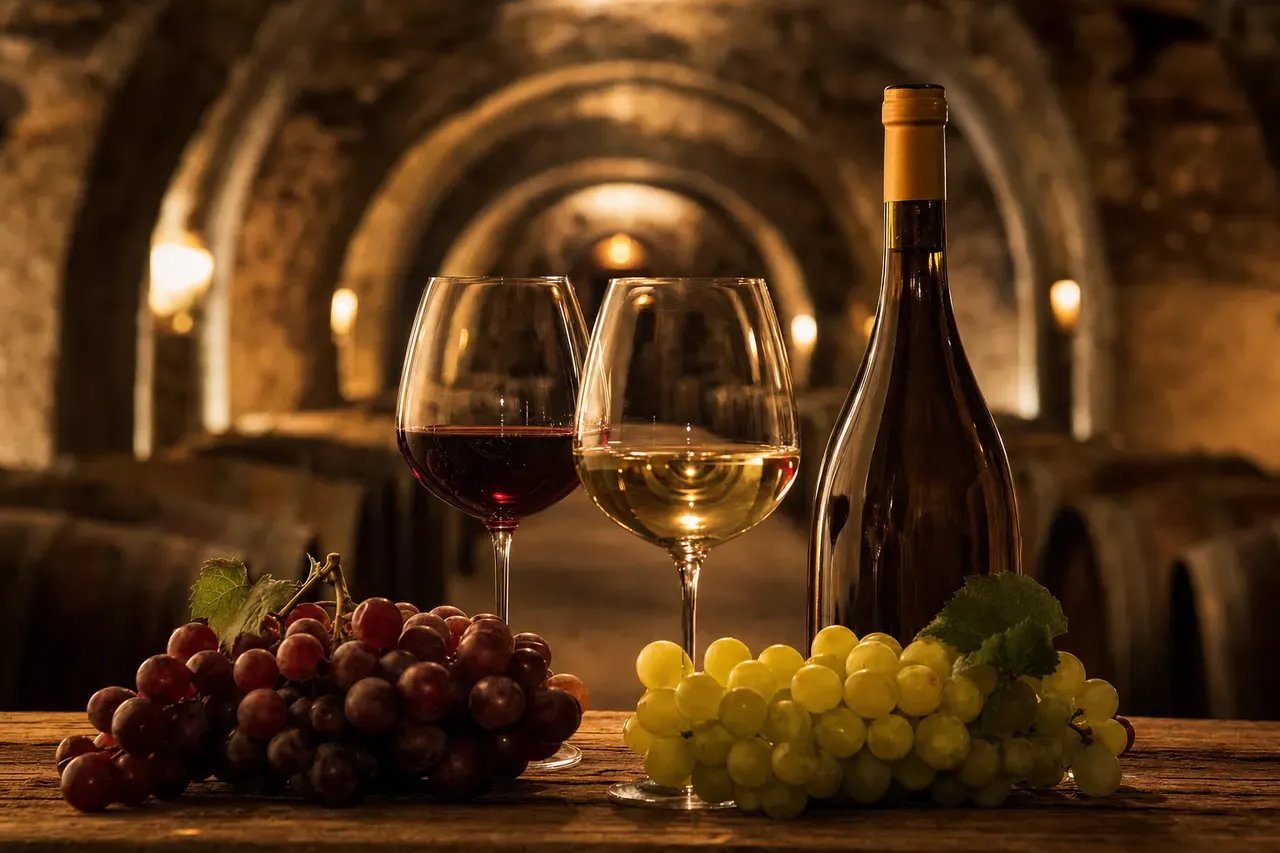
Louis XIV called it “the wine of kings and the king of wines”, and for once the marketing line is historically accurate. Tokaj was classified in 1737 — decades before Bordeaux — making it the world’s first closed wine region. Since 2002 it has been a UNESCO World Heritage site.
The grapes
| Variety | Share | Character |
|---|---|---|
| Furmint | ~70% | High acid, mineral, long-lived |
| Hárslevelű | ~20% | Aromatic, honeyed, floral |
| Sárga muskotály | ~5% | Perfumed, muscat-like |
| Zéta, kövérszőlő, kabar | ~5% | Supporting varieties |
Furmint’s razor-sharp acidity is the secret of the whole region: it is why even the sweetest wines here taste fresh rather than cloying, and why they age for decades.
Aszú: how it is made
Aszú berries are grapes concentrated by noble rot — a fungus that, in the right humid-then-dry autumn conditions, dehydrates the fruit and concentrates sugar, acid and aroma. The process is brutally labour-intensive:
- Affected berries are picked individually, by hand, over several passes.
- They are crushed and steeped in a base wine or fresh must.
- After a few days of maceration the mass is pressed.
- The wine is aged in barrel — at least 18 months by law, often far longer.
The result is sweet but sharply defined: apricot, honey, orange peel, with an extraordinarily long finish.
What “puttonyos” means
A puttony was a 25 kg basket. The number told you how many baskets of aszú berries went into a 136-litre barrel of base wine — so more puttonyos meant sweeter and more concentrated. Classification is now based on residual sugar, but you will still see the word, and it still signals ambition.
Beyond aszú
- Dry furmint — the region’s biggest recent success. Crisp, stony, savoury, brilliant with fish and poultry, and a fraction of the price of aszú.
- Szamorodni — made from whole bunches, so sweetness depends on how many berries were botrytised. The dry version is oxidative and sherry-like.
- Late harvest — a softer, sweeter entry point if aszú feels too intense.
- Eszencia — the free-run juice of aszú berries; extraordinarily sweet, barely alcoholic, spoon-worthy, and very rare.
Tasting and pairing
| Wine | Serve at | Pair with |
|---|---|---|
| Dry furmint | 10–12 °C | Fish, poultry, hard cheese |
| Szamorodni (dry) | 12–14 °C | Aged cheese, walnuts |
| Late harvest | 10 °C | Fruit desserts |
| Aszú | 10–12 °C | Foie gras, blue cheese, dessert |
Do not over-chill aszú: too cold and the aromatics disappear. Pour small amounts into a small glass — this is a concentrated wine, not a thirst-quencher.
Visiting
The cellars of Tokaj — long tunnels cut into volcanic rock, walls furry with Cladosporium cellare mould — are open to visitors, and a cellar tour explains the wine better than any article can. Tokaj is about 2.5 hours by car from Budapest, or reachable by train via Miskolc.
Read more, in Hungarian: our guides to Tokaji wines, the Hungarian wine regions and Hungarian grape varieties.